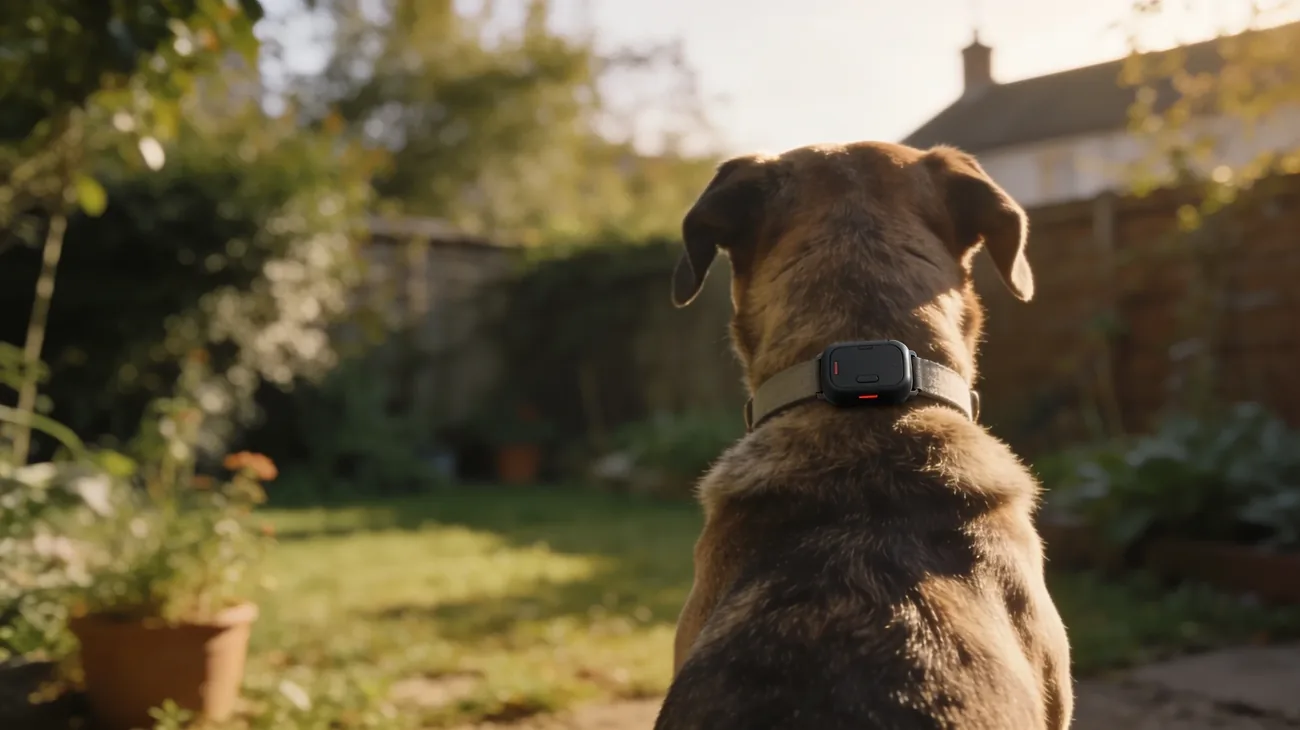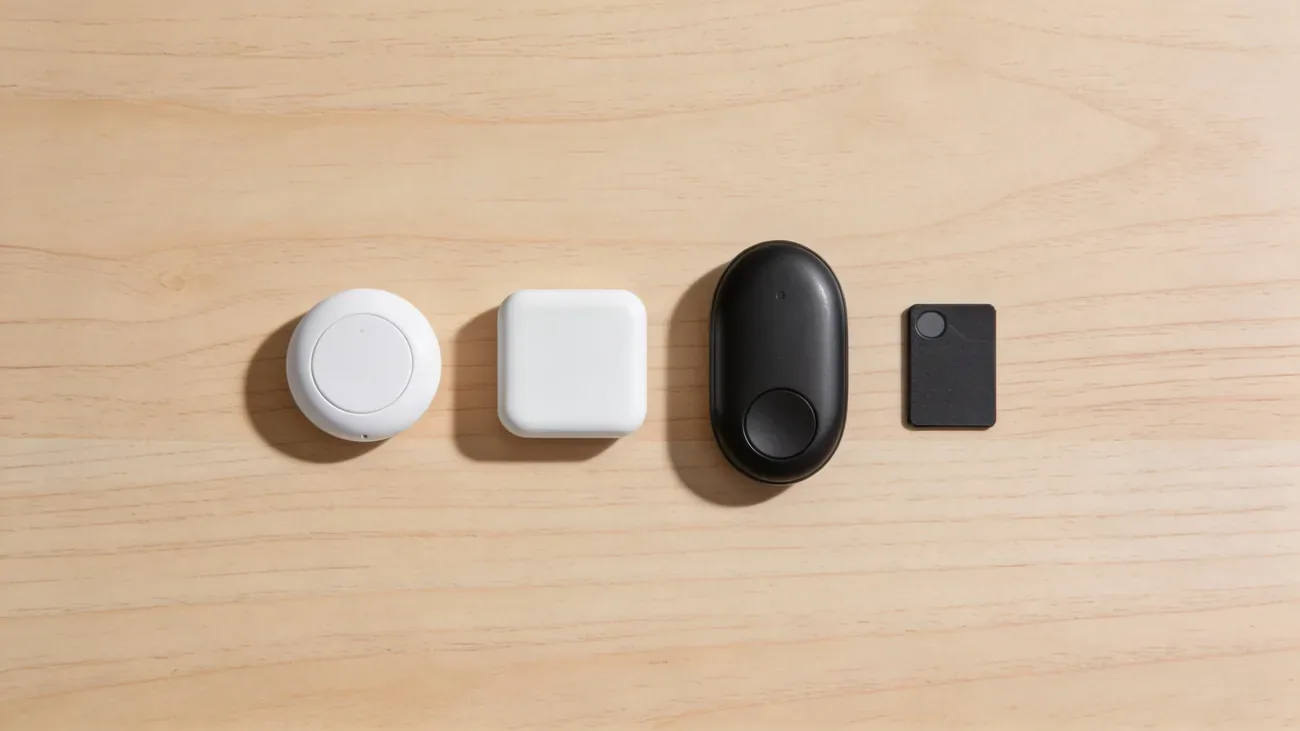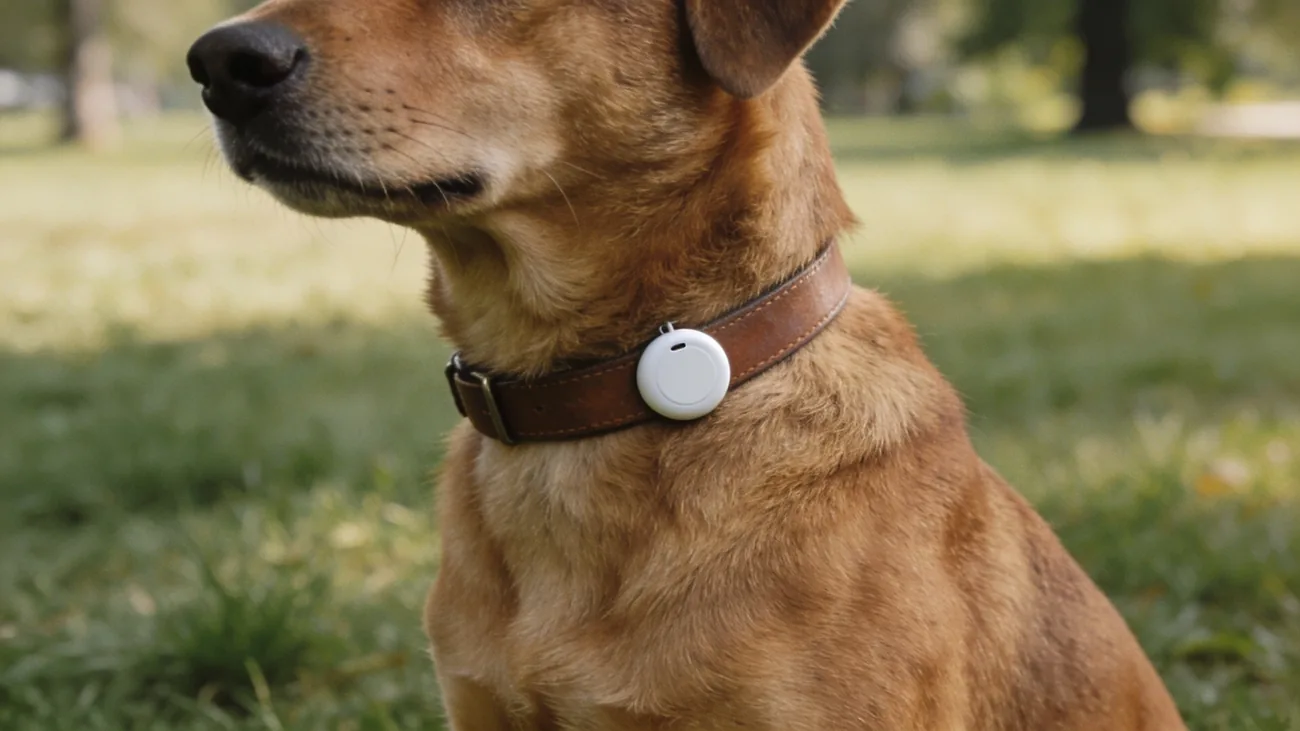
First things first: You can clip an AirTag to a dog collar, but Apple designed it for keys and bags, not pets. It has no GPS and only updates when an Apple device passes nearby, so it works as a cheap backup in the city and fails as a primary tracker in the countryside.
Table of contents
Yes, an AirTag fits on a dog collar, and thousands of owners do it. But Apple built the AirTag to find keys and backpacks, not to track a moving animal, and that design choice shapes everything about how it behaves on a dog. In a dense neighborhood it can work as a cheap backup. Anywhere else, it is the wrong primary tracker.
This guide explains what the tag can and cannot do on a collar, the physical risks vets warn about, and how it compares to a real GPS tracker and a microchip.
How an AirTag actually finds things
An AirTag has no GPS receiver and no cellular connection. It is a small Bluetooth beacon with an ultra-wideband chip and a replaceable CR2032 coin battery. It broadcasts an encrypted signal, and any nearby iPhone, iPad, or Mac that hears it relays the tag’s position to Apple’s Find My network. The tag itself never knows where it is. It only knows it was heard.
Three consequences follow, and they explain nearly every complaint about pet use:
- Updates need strangers’ phones. In a city full of iPhones, a lost dog’s tag can ping every few minutes. Where there are no Apple devices in Bluetooth range, roughly a few dozen feet, the map simply stops updating.
- Locations are history, not live. Find My shows where the tag was when it was last heard. A moving dog is already somewhere else by the time you arrive.
- Close range is the strong suit. At home, Precision Finding on iPhone 11 and newer can point you toward the tag, and you can play a sound. That is the item-finding job the product was built for.
Two related features matter for dogs. Lost Mode lets you attach a message and contact details that appear when someone taps the found tag with NFC, including from an Android phone. Android owners cannot actively track an AirTag in Find My, though, so an Android-only household gets read-only value. Our explainer on whether AirTag works without an iPhone nearby covers the network mechanics in more depth.
Why Apple says it is not for pets
Apple has been consistent since launch: AirTag is designed for personal belongings, not people or pets. A company spokesperson put it plainly in press coverage: the product was designed to help people locate their belongings, not pets. The user guide carries the same message.
This is engineering reality, not legal caution. The ping interval, battery design, and anti-stalking system all assume an item that mostly sits still. A dog at a dog park is the opposite case. One awkward side effect: Apple’s unwanted-tracking alerts can fire on a dog walker, sitter, or neighbor whose phone travels with your dog for a while, warning them that an unknown AirTag is moving with them. On a pet, a safety feature becomes a false alarm.
What goes wrong on a dog
Beyond stale locations, three physical risks come up often enough in vet practices and owner reports to take seriously.
Swallowing. An AirTag is about 32 mm across, small enough for a medium or large dog to gulp if it breaks loose. Widely reported cases, collected by outlets including the Wall Street Journal and AppleInsider, describe dogs that swallowed the whole tag and needed monitoring, induced vomiting, or surgery. The danger multiplies if chewing exposes the coin battery, which can burn mouth and stomach tissue. Vets treat battery ingestion as an emergency.
Chewing damage. Even without swallowing, a determined chewer can crack the plastic shell. Once the case is compromised, the water seal fails and the tag dies in the next rain. Holders that fully encase the tag with a screw or snap closure survive far longer than soft silicone sleeves. Inspect the holder weekly for cracks, loose screws, and worn clips.
Water exposure. IP67 means rain, splashes, and brief shallow immersion. It does not mean swimming. A retriever or any dog that paddles regularly will eventually flood the tag, and salt and grit wear the seal faster. Purpose-built GPS dog trackers are sealed for full swimming, which is one of the clearest dividing lines between the two product types.
If you use a tag anyway, the attachment rules are simple: a hard-shell holder that threads through the collar webbing, no dangling mount a second dog can grab, and a collar fit you check as often as you check the battery.
AirTag vs GPS tracker vs microchip
These three products answer different questions. The tag asks “where was it last heard,” the GPS collar asks “where is the dog right now,” and the microchip answers “whose dog is this” at a vet or shelter.
| Feature | AirTag | Cellular GPS dog tracker | Microchip |
|---|---|---|---|
| Location source | Bluetooth via passing Apple devices | GPS satellites plus cellular upload | None, ID only |
| Real-time tracking | No, last-known position only | Yes, live mode with frequent updates | No |
| Range | Wherever iPhones pass by | Anywhere with cellular coverage | N/A |
| Subscription | None | Required, covers the built-in SIM | None after implant |
| Battery | CR2032, about a year | Rechargeable, roughly weekly charging | None needed |
| Water resistance | IP67, splash level | Swim-rated on pet models | Sealed under skin |
| Escape alerts | No virtual fence | Yes, safe-zone alerts | No |
| If a stranger finds the dog | NFC tap shows your message | Depends on model | Shelter scans the chip |
The honest read: AirTag wins on price and battery life, and loses on every axis that matters during an active search. A GPS tracker is the right primary tracker for hiking dogs, rural dogs, swimmers, escape artists, and any dog whose owner cannot accept a location that is hours old.
A UK maker’s published field test illustrates the gap. PitPat placed AirTags and its own GPS tracker in three locations for a day and found the AirTag fixes lagging an hour or more on average, with no live follow-up, while the GPS unit locked on in well under two minutes and then updated continuously. It is the vendor’s own test, so read it as directional rather than gospel, but the mechanism behind the result is not disputed: crowd-relayed Bluetooth cannot match a device with its own GPS and cellular radio.
When an AirTag is enough, and when it is not
An AirTag earns its place in a few narrow setups:
- A city dog that is fenced or leashed almost always, moving through dense iPhone coverage. The tag is a low-cost safety net if the leash hand fails.
- A backup tag on a dog that already wears a GPS collar. Trackers fail too: dead battery, lost signal, forgotten charge. A $29 tag in a separate holder is redundancy, not duplication.
- A carrier or crate tag for travel. Tracking luggage-like items is exactly the job the product was built for.
Everything else points to GPS: trail and hunting dogs, off-leash roamers, swimmers, rural dogs, and frequent escapees who need an instant alert the moment they leave the yard. For a detailed side-by-side, see our AirTag vs GPS dog tracker comparison. For cats, where weight and breakaway collars change the math, see our Bluetooth tracker picks for cat collars.
Setup checklist if you use one anyway
If your dog fits the narrow cases above, set the tag up properly instead of clipping it on and hoping.
- Pair the tag near your iPhone, name it clearly, and assign it in the Items tab of Find My.
- Mount it in a hard-shell holder threaded through the collar, then tug-test the whole assembly.
- Enable Lost Mode details in advance: phone number and a short message for whoever taps the tag.
- Walk your usual route with Find My open and note where updates stall. Dead zones near home mean the tag cannot be your only layer.
- Set a calendar reminder to swap the CR2032 before the year mark, and pair every battery check with a holder inspection. Our AirTag battery guide has the full routine.
None of this turns a Bluetooth beacon into a GPS tracker. It just makes the backup layer as reliable as the hardware allows.
The short decision
Buy a GPS tracker as the primary layer for any dog that hikes, swims, roams, or lives outside dense phone coverage. Add an AirTag in a hard-shell holder only as cheap city redundancy or travel backup. And whatever electronics you choose, keep the microchip and ID tag: they are the layers that work when every battery is dead.
Frequently asked questions
Can an AirTag actually find a lost dog?
Sometimes, and only near people. AirTag has no GPS of its own. It broadcasts a Bluetooth signal that nearby iPhones relay to the Find My network, so your map shows where the tag was when a phone last passed it. In a busy neighborhood that can mean an update every few minutes. On a trail or in a rural area with no iPhones around, the location can sit stale for hours while your dog keeps moving.
Does Apple allow AirTags on pets?
No. Apple states that AirTag is designed to track personal belongings, not people or pets, and has repeated that position since launch. The product was tuned for items that mostly sit still, like keys and backpacks, not for a moving animal. Apple's unwanted-tracking alerts can also confuse a dog walker or neighbor whose phone travels with your dog and warns them that an unknown AirTag is moving with them.
Can a dog swallow an AirTag, and what happens then?
Yes, and it has happened. At about 32 mm across, an AirTag is small enough for a medium or large dog to swallow if it breaks loose from its holder, and chewers can crack the case. The CR2032 coin battery inside can burn tissue if it is exposed or lodged, which vets treat as an emergency. Widely reported cases include dogs that swallowed the whole tag and needed monitoring, induced vomiting, or surgery. Use a hard-shell holder that fully encases the tag.
Is an AirTag waterproof enough for a dog that swims?
No. AirTag is rated IP67, which covers splashes, rain, and brief shallow immersion, not swimming. A dog that paddles in lakes or the sea will eventually flood the seal, especially once the case has taken a few knocks. Purpose-built GPS dog trackers are sealed for full swimming. If your dog goes in the water regularly, treat the AirTag as the wrong tool for that dog.
AirTag or GPS tracker for a dog: which is better?
A GPS tracker is the better primary tracker for almost every dog. It carries its own GPS receiver and cellular connection, so it reports live position without depending on strangers' phones, and it adds escape alerts when the dog leaves a safe zone. An AirTag wins on price and battery life only. Our full [AirTag vs GPS dog tracker comparison](/guides/airtag-vs-gps-dog-tracker/) walks through the trade in detail.
Do I still need a microchip if my dog wears an AirTag?
Yes. A microchip is permanent identification that any vet or shelter can scan, it needs no battery, and it cannot fall off. An AirTag is a consumer gadget that can break, run out of battery, or lose signal at the worst moment. Trackers and chips solve different problems: the tracker helps you search, the chip proves the found dog is yours. Our [microchip vs GPS tracker guide](/guides/dog-microchip-vs-gps-tracker/) explains how they complement each other.